Cryptorchidism (Undescended Testicles) in Horses
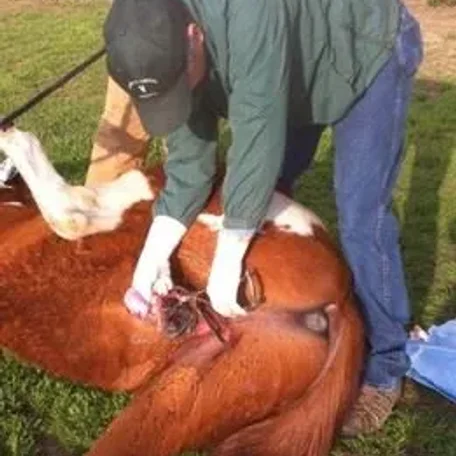
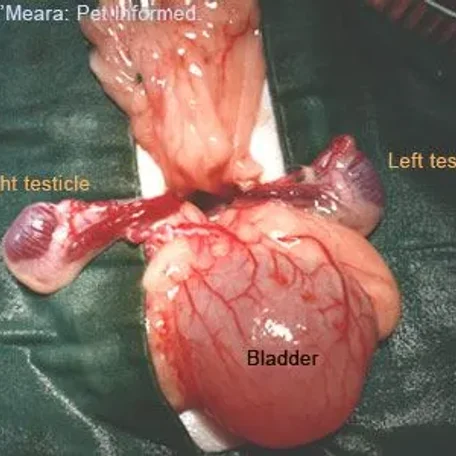
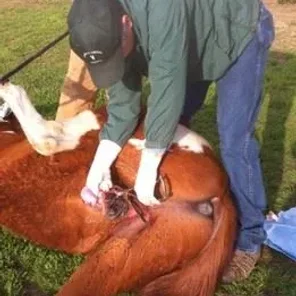
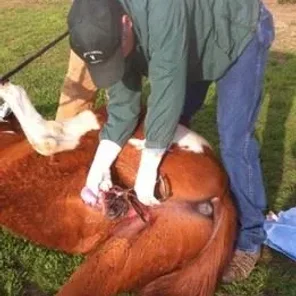
Figure 1. This photograph of an undescended testicle (black arrow) was taken during laproscopic surgery on a cryptorchid horse. The testicle (black arrow) is resting in the abdomen next to the inguinal canal (white arrow).
French Trotter
Dutch Harness
Castillonnais
Gidran
Bardigiano
Friesian Cross
Bavarian Warmblood
Dutch Warmblood
Donkey
Gelderland
Chilean Corralero
Carolina Marsh Tacky
Friesian Sport Horse
Coldblood Trotter
Karpass
Giara
Belgian Draft
Maltese
Brumby
Berry Black
Campolina
Mini (Miniature Mediterranean)
Mary (Maryiskaya, Merv)
Gypsy Cob
Mammoth Jackstock (American Mammoth)
Black Forest
Brazilian Sport Horse
Horse
Byelorussian Harness
Anatolia
Basque Mountain
Galiceno
Boulonnais
Furioso-North Star
Blazer
Freiberger
Finnhorse
Brandenburger
Breton
Danube Delta
Estonian
Florida Cracker
Czech Warmblood
Catalan
Groningen Horse
Georgian Grande
Camargue
Falabella
Canadian Pacer
Friesian
Robert Neal
Apr 13, 2015
4 photos
2 links
In a normal horse, only the spermatic cord (black arrowhead) would be seen passing through the canal, and the testicle would be located external to the abdomen within the scrotum.
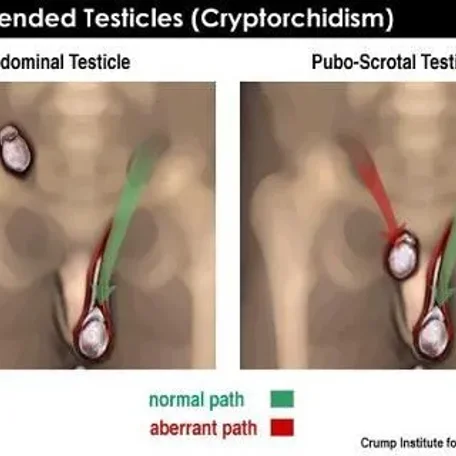
Cryptorchidism means, "hidden testes" (crypt = hidden, orchid = testes).
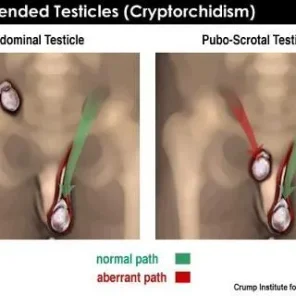
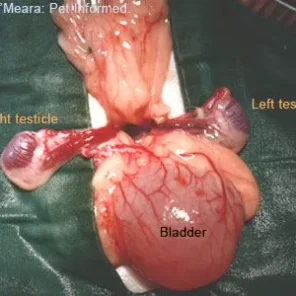
This term describes the condition in which one (unilateral) or both (bilateral) testicles do not descend normally into the scrotum. Generally, unilateral cryptorchids are usually fertile, while bilateral cryptorchids are generally sterile. The retained testicle may be located anywhere from within the abdomen to within the inguinal canal, which is the normal passage route into the scrotum (Figure 1). A single cause of equine cryptorchidism has not been established and contributing causes remain obscure. The condition is likely the result of a complex combination of genetic, hormonal, and mechanical factors.
Prevalence of left and right testicular retention is nearly equal, though retained left testes are more often in the abdomen while the right retained testicle is more often in the inguinal canal. All breeds of horses may be exhibit cryptorchidism, but there is a higher frequency in Quarter Horses, Saddlebreds, Percherons, and ponies. The condition is considered heritable, so affected pets should be gelded to help prevent continuation of this congenital defect and for safety/behavioral reasons (although a testicle is undescended, it still produces male hormones leading to characteristic stallion behavior). Also, many breed associations do not allow registration of cryptorchids.
Cryptorchid horses usually exhibit standard stallion behavior, but visibly/palpably lack one or both scrotal testicles.
Immature horses may be undetected until they are examined just prior to routine castration.
Mature horses with no detectable testes that behave like stallions may be a:
Bilateral cryptorchid
Unilateral cryptorchid with the descended testes previously removed
Geldings with stallion-like behavior (castrated later in life +/- previous breeding stallion).
Monorchidism (complete absence of one testicle) is rare in the horse and should only be considered after extensive testing and, potentially, surgical exploration.
You primary care veterinarian may recommend performing the following diagnostics:
Combination of external and rectal palpation +/- ultrasonographic examination to locate a testicle within the abdomen or inguinal canal.
Blood tests measuring testosterone and conjugated estrogens when there is incomplete surgical history or absence of externally palpable testicles (~95% accurate, both tests should be performed if either is inconclusive).
Testosterone levels: Measured in the blood before and after administration of human chorionic gonadotropin (hCG).
Stallions and cryptorchids have higher levels of testosterone and levels of the hormone increase after hCG administration.
Castrated horses have low levels of testosterone that do not increase after hCG administration.
Conjugated estrogen levels: Typically, levels are higher in horses with testicular tissue, and a single measurement can often identify cryptorchids. Unreliable in horses younger than 3 years and in donkeys.
An ACVS board-certified veterinary surgeon should perform the identification and surgical removal of undescended testicles. The anatomy in this area is very complex and testicles are often smaller than normal and may be abnormally formed / shaped with an abnormal appearance. Veterinary surgeons trained according to the standards of the American College of Veterinary Surgeons have specific knowledge and skills for diagnosis and treatment of cryptorchidism in the horse.

published an article